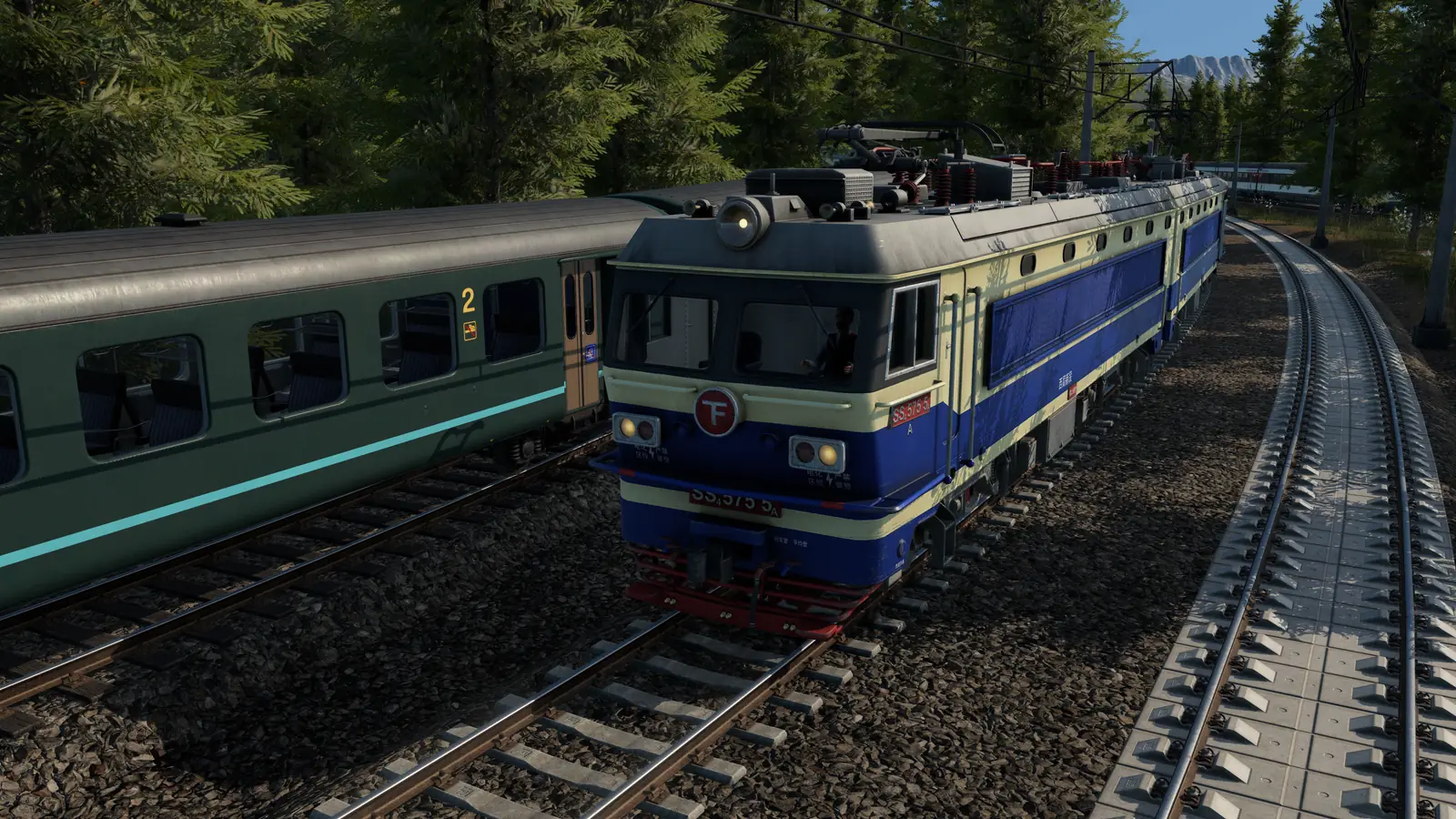
How trains work in Transport Fever 3
Everything in this section comes from the official game manual, put in our own words. A train is a locomotive with wagons coupled behind it: the locomotive drives and the wagons carry the load. A few trains need no wagons at all, such as a rail bus, a single diesel unit that carries passengers.
- Propulsion and track. Locomotives are sorted by propulsion: steam, fuel or electric. The store labels fuel locomotives Diesel. Trains run on railway track or on electrified railway track, depending on their propulsion.
- Top speed. The slowest vehicle in a train sets the top speed of the whole train, which is why the manual advises locomotives and wagons with similar top speeds.
- Wagons. Wagons are grouped by cargo type: bulk, fuel, general and passengers. Passenger wagons carry only passengers. A cargo wagon is refitted at a station when it needs to carry something else, but only within its own type: an open wagon, for example, can take coal, iron ore, stone, grain or slag and nothing else.
- Passengers and cargo together. Any wagons can be coupled together, so one train can carry passengers and cargo at the same time, although the manual says this is usually not a good idea. Any train can stop at both passenger and cargo stations, but passengers only board at passenger stations and cargo is only loaded at cargo stations.
Train power and tractive effort
Power is what a train needs to run fast or haul weight; tractive effort, the most force a locomotive has at low speed, gets it moving and helps it pick up speed from a standstill. As a rule of thumb, cargo locomotives lean towards tractive effort and passenger or high-speed locomotives towards power. A locomotive pulls with the lower of two forces: its tractive effort, or its power divided by its speed. So tractive effort sets how hard it pulls from a standstill and at low speed, and power how hard it pulls once it runs fast. You can couple several locomotives in one train to give it more power.
The train builder adds up the power and tractive effort of every locomotive and multiple unit in a train, divides the power by the train's weight and shows the speed up to which the train pulls with its full tractive effort, so you can compare trains. The most powerful in our list are the Chinese Class SS4G among locomotives (8,700 kW, on sale from 1980) and the ICE 1 among multiple units (9,580 kW, from 1991). The most tractive effort, 700 kN, belongs to the TGV Duplex. Among locomotives, the ALCO 4-8-8-4 Big Boy pulls with its full 602 kN up to about 27 km/h, and the EMD AEM-7 keeps its full pull up to about 117 km/h: a freight engine gets a heavy train moving, a fast passenger engine keeps pulling hard at speed.
Shunting and changing a train
The manual describes no shunting: nothing about coupling or uncoupling wagons on the track, and no shunting yards. A train you already own can be changed in the vehicle manager: one of its buttons lets you move wagons within a train or between selected trains, and add more to a train. The same window can also reverse the direction the train runs on its line.
Shunting has been a common wish since before the release: locomotives that uncouple, run around their train and couple again, and yards where wagons are sorted. Urban Games has not answered it yet.
How the train builder adds up a train
Every number the builder shows is a sum or a minimum of numbers in the vehicle list, where every number has been checked before it goes in. One of them is marked as an estimate: the whole train's running cost, which is each vehicle's listed cost added up.
- Length is the length of every vehicle added together.
- Station modules. The manual says rail stations are extended in modules of 40 meters, so the builder divides the train's length by 40 and rounds up. It does not say how long a new station is before you extend it: you choose that in the settings when you build it.
- Top speed is the lowest top speed in the train, because the slowest vehicle sets it. When a faster vehicle is held back, the builder names the one that does it.
- Capacity adds up passengers and, separately, each kind of cargo.
- Power and tractive effort add up every locomotive and multiple unit. Power per tonne divides the power by the weight the store lists for all vehicles. It is our own ratio for comparing trains, not a number the game shows.
- Price adds up the store prices, and running cost adds up each vehicle's yearly running cost. Prices depend on your difficulty settings; the vehicle list explains which settings ours come from.
- Year. Enter the year your game is in, and both tools only offer what the store sells then. The vehicle unlock dates guide explains how those years work.
An example. The train the builder opens with is a 2-6-0 Mogul pulling 4 Compartment Cars. It is 63 meters long, so it needs 2 station modules, 80 meters of platform. The 2-6-0 Mogul could do 75 km/h, but the coaches hold the train to 60 km/h. It seats 48 passengers, costs $3,096,078 and $516,013 a year to run. Coaches with a top speed of 75 km/h or more would let the locomotive use its full speed.
Platforms and stations
When a platform is shorter than the train using it, loading and unloading slow down, and the vehicle window, the station window and the terminal dialog show a warning. That makes the length of your longest train the length your platforms should have. A new rail station: up to eight tracks, as a through station or a terminus. Track modules let you electrify only some tracks, or turn single tracks into high-speed tracks. The stations guide covers building and extending them, and the train signals guide how trains share a line.
The fastest train in each era
The fastest locomotive or multiple unit in our list by the year it first goes on sale. No game starts before 1900, so the first row is what you can buy in the earliest start year. Trains that are not in the list yet may be faster.
| On sale from | Fastest train | Top speed | First year |
|---|---|---|---|
| Before 1900 | 2-6-0 MogulLocomotive · Steam | 75 km/h | 1885 |
| 1900–1929 | Russian Class SULocomotive · Steam | 115 km/h | 1927 |
| 1930–1959 | Pennsylvanian Class GG1Locomotive · Electric | 160 km/h | 1934 |
| 1960–1989 | Italian Class ETR 450Multiple unit · Electric | 250 km/h | 1985 |
| 1990 onward | Fuxing HaoMultiple unit | 350 km/h | 2016 |
Locomotive list: all 30 locomotives
Every locomotive in the game's vehicle store, by the year it first goes on sale. Multiple units, which carry passengers themselves, and the wagons are in the vehicle list. One of those multiple units, the ACF M-300, is set against a locomotive with coaches, seat by seat, on a page of its own.
| Locomotive | On sale | Top speed | Price |
|---|---|---|---|
| Prussian Class T 3Steam | 1882–1920 | 50 km/h | $1,094,868 |
| 2-6-0 MogulSteam | 1885–1930 | 75 km/h | $1,912,398 |
| Russian Class OBSteam | 1890–1940 | 60 km/h | $2,265,576 |
| 4-4-2 AtlanticSteam | 1906–1950 | 100 km/h | $3,076,356 |
| Baden Class VI cSteam | 1914–1960 | 90 km/h | $2,626,134 |
| Chinese Class JF1Steam | 1918–1965 | 80 km/h | $5,390,976 |
| Ce 6/8 II CrocodileElectric | 1921–1960 | 90 km/h | $7,470,888 |
| Russian Class SUSteam | 1927–1970 | 115 km/h | $5,132,868 |
| ALCO HH 600Diesel | 1930–1975 | 70 km/h | $1,099,191 |
| Pennsylvanian Class GG1Electric | 1934–1980 | 160 km/h | $11,687,898 |
| British Class A4Steam | 1935–1975 | 145 km/h | $7,922,934 |
| German Class E 94Electric | 1940–1985 | 90 km/h | $13,583,436 |
| ALCO 4-8-8-4 Big BoySteam | 1941–1980 | 130 km/h | $18,693,072 |
| Swiss Re 4/4 IElectric | 1946–1990 | 125 km/h | $7,660,104 |
| EMD F-UnitDiesel | 1949–1990 | 130 km/h | $9,018,588 |
| Chinese Class RMSteam | 1958–1985 | 110 km/h | $4,453,194 |
| German Class V 100Diesel | 1958–2000 | 90 km/h | $3,663,000 |
| Austrian Class 1042Electric | 1960–2000 | 140 km/h | $13,279,128 |
| EMD SD40-2Diesel | 1972–2010 | 105 km/h | $13,008,504 |
| Chinese Class DF5Diesel | 1976–2015 | 80 km/h | $5,625,366 |
| EMD AEM-7Electric | 1978–2015 | 200 km/h | $15,991,428 |
| Chinese Class SS4GElectric | 1980–2020 | 100 km/h | $38,234,712 |
| Chinese Class DF4BDiesel | 1984–2025 | 120 km/h | $11,089,068 |
| Japanese Class EF66Electric | 1989–2025 | 120 km/h | $16,319,760 |
| GE P42DCDiesel | from 1995 | 160 km/h | $12,350,214 |
| Norwegian Class EL 18Electric | from 1996 | 200 km/h | $39,978,576 |
| German Class 185Electric | from 2000 | 160 km/h | $16,363,056 |
| German Class 246Diesel | from 2008 | 160 km/h | $8,571,126 |
| Chinese Class HXD3BElectric | from 2009 | 120 km/h | $40,171,710 |
| Stadler Eurodual | from 2018 | 160 km/h | $27,271,764 |
Which trains are in the list
The list holds 90 trains so far, and the game has more. Each one is in the vehicle list too. The builder can use 88 of them, the ones whose length and weight are checked: 30 of 30 locomotives, 17 of 17 multiple units, 14 of 16 passenger wagons, and 27 of 27 cargo wagons. The British Mark 3 Coach and Swiss DPZ Coach are in the table above but not in the builder yet: we have no checked length or weight for them. Seen different numbers in your game? Tell us which train and what the store shows.
Frequently asked questions
How many wagons can a locomotive pull in Transport Fever 3?
There is no fixed number: it depends on how heavy the wagons are and how fast the train has to go. A locomotive pulls with the lower of two forces: its tractive effort, or its power divided by its speed. So tractive effort sets how hard it pulls from a standstill and at low speed, and power how hard it pulls once it runs fast. You can couple several locomotives in one train to give it more power. The train builder on this page shows the power per tonne of every train you put together and the speed up to which its engines pull with their full tractive effort, so you can compare them.
How long does a train platform need to be?
At least as long as the train. When a platform is shorter than the train using it, loading and unloading slow down, and the vehicle window, the station window and the terminal dialog show a warning. Rail stations are extended in modules of 40 meters, and the train builder shows how many of those your train needs.
Why is my train slower than its locomotive?
The slowest vehicle in a train sets the top speed of the whole train, which is why the manual advises locomotives and wagons with similar top speeds. A fast locomotive pulling slower wagons runs at the speed of the slowest wagon.
Can one train carry passengers and cargo?
Yes. Any wagons can be coupled together, so one train can carry passengers and cargo at the same time, although the manual says this is usually not a good idea. Any train can stop at both passenger and cargo stations, but passengers only board at passenger stations and cargo is only loaded at cargo stations.
Do electric trains need special track?
Yes. Trains run on railway track or on electrified railway track, depending on their propulsion. So an electric locomotive or multiple unit needs electrified track. Inside a station, track modules let you electrify only some tracks, or turn single tracks into high-speed tracks.
What is the fastest train in Transport Fever 3?
Of the 47 locomotives and multiple units with a confirmed top speed in our list, the fastest is the Fuxing Hao at 350 km/h, on sale from 2016. The list does not hold every train in the game yet.
Sources
- Official manual, Vehicles (how trains are put together, power, tractive effort, wagon types, revised September 28, 2026)
- Official manual, Lines and Vehicles (platforms shorter than the train, changing a train, revised September 29, 2026)
- Official manual, Stations and Depots (building and configuring stations, every station type, depots and maintenance, revised September 29, 2026)
- Official manual, Lines and Vehicles (why a platform shorter than the train slows loading and unloading, revised September 29, 2026)
- Train numbers: the vehicle list.
Manual rules checked on October 20, 2026.