How the production chain calculator works out a chain
Every processing industry turns a fixed set of input cargo into output cargo in one production run. The planner divides the amount you ask for by the output of one run, rounds up to whole runs, and multiplies the inputs by that number. It then does the same for each input until it reaches raw materials.
Some industries make more than one cargo at once: Chemical Plant, Livestock Farm, Oil Refinery, Saw Mill, and Steel Mill. Each of them runs only as often as its most demanded output needs, and everything else it makes is listed as extra cargo. That way an industry that appears in two branches of a chain is counted once, not twice.
Raw industries (mines, pits, most farms, the Logging Camp and others) need no input. The manual gives their output as a range, for example 1–16 Coal for a Coal Mine, because it depends on how many plots (fields, mine shafts and so on) the industry has. The planner shows that range rather than inventing a fixed number.
Climate zones and missing links
The manual's industries table does not list every industry for every climate. When an industry in the chain is not listed for the climate you picked, the planner names the missing cargo, says where its producer is listed and offers the climates where the whole chain can be finished.
The manual says the climate changes how the map looks and its terrain but has no direct effect on the simulation. When you start a game, Advanced › Industries in the settings can switch to a different economy, and mods can add more, so check that setting when you start a map.
Where the game offers two routes, you choose: the Canning Factory takes either Fish or Meat, and Wool comes from either a Cotton Farm or a Livestock Farm. The choices appear under the settings as soon as they matter for your plan.
How many industries a step needs
The plan above counts production runs, not factories, because the manual never says how long a run takes. The game does show it, though: under Production, every industry's window lists what it made over the last 365 days next to Max., the most it could make in a year. In the How many industries you need box, pick a step of your plan, type in that figure, and the planner divides the yearly amount by it and rounds up. Max. is a ceiling, so the answer is the smallest number of industries that can keep up when every input arrives on time; workers boost an industry, so read the figure from one like those you will build.
How many vehicles a delivery needs
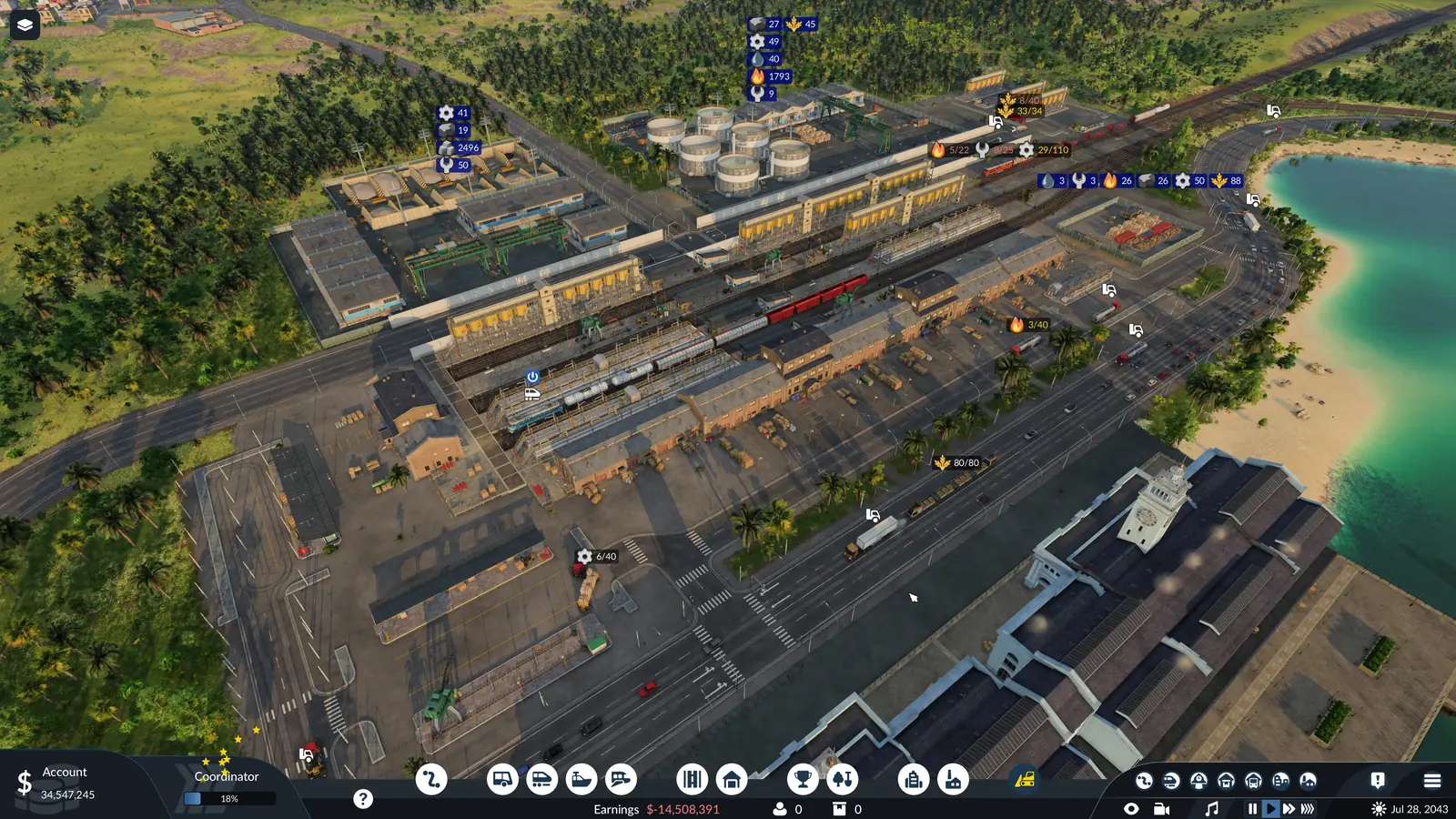
Every arrow in a chain is a line you have to run, and the planner lists each one in the How many vehicles you need box: the cargo, how much of it, where it comes from and where it goes. The manual gives no trip times and no production speed, so instead of guessing them the planner uses a number the game shows you. Rate is the average number of passengers or cargo units the line carries per station in a year. With a few vehicles on a line, the line window shows its rate; the planner scales that up to the amount the delivery needs. That works only while the line is short of vehicles, and the cargo waiting at the industry it comes from tells you whether it is: when cargo piles up there, more vehicles carry more; when little waits, the line already takes all the industry makes, and the industry has to make more first. The box asks which it is and says what to do.
For this, treat the amount you enter at the top as a yearly target. The rate is a yearly figure, so every delivery then is too. More vehicles carry more only while the stations, the track and the loading keep up; the line manager guide shows what to do when a line is full. What each of those deliveries earns, at the same rate per metre for every cargo, is worked out in the money guide.
How the planner counts
- Recipes per run, output per year from your game. Every amount comes from the ratio of one production run. How many industries you need comes from the Max. figure in an industry's window, the most it can make in a year, so the count follows the industries on your own map.
- Boosters. Delivering Fertilizer, Machines, or Tools to a raw industry, or bringing workers by passenger line, raises output but is optional. Boosters are listed next to each raw industry instead of being added to the totals.
- Campaign cargo. Covers free game mode only. Campaign missions can add special cargo and industries that the manual leaves out.
Frequently asked questions
Is there a production chain calculator for Transport Fever 3?
Yes, this planner. Pick one of the 36 cargo types, an amount and a climate, and it lists every industry in the chain, how many production runs each one needs, the raw materials at the start and the extra cargo you will have to move. With two figures from the game it also works out how many industries each step needs and how many vehicles each delivery needs. Each plan has its own link, so you can share it.
How do production chains work in Transport Fever 3?
A raw industry needs no deliveries and always makes some cargo. Every other industry stays idle until cargo is sitting in its input stock. The recipe at the top of its window names that cargo. Chains end in 10 end products (Beverages, Books, Bricks, Canned Food, Cement, Clothes, Fuel, Furniture, Vegetables, and Vehicles), which town districts use. Nothing moves on its own: you connect every step with a line.
How many factories do I need for a production chain?
Read one figure in your game and the planner works out the rest. Under Production, an industry's window shows what it made over the last 365 days next to Max., the most it could make in a year; in the planner's How many industries you need box, pick a step and enter that figure. If a step needs 500 a year and one industry makes at most 200, you need at least 3, as long as every one makes its Max. with all its inputs on time. The recipe is for one run, so the count always comes from that yearly figure. One Vehicles cargo, for example, takes 1 Vehicle Factory run, 1 Machine Factory run, 1 Chemical Plant run, 2 Oil Refinery runs, and 3 Steel Mill runs: the Vehicle Factory needs 1 Tires, 4 Sheet Metal, and 1 Machines, and the whole chain starts from 18 Iron Ore, 18 Coal, and 8 Crude Oil.
Is Max. in the industry window per year?
Yes. Under Production, an industry's window shows what it used and made over the last 365 days next to Max., the most it could make in a year, so both are yearly figures, like the planner's Amount per year: a Max. of 200 means 200 a year. Max. is a ceiling: an industry other than a raw one makes nothing until its inputs arrive, and workers boost any industry, so what it makes over a year can fall well short of it.
How many trucks or trains do I need for a production chain?
Scale up from what the line already carries. Rate is the average number of passengers or cargo units the line carries per station in a year. In the planner's How many vehicles you need box, pick a delivery from your plan and enter how many vehicles its line has and the rate the line window shows. If 2 vehicles carry 300 a year and the delivery needs 600 a year, the line needs about 4. The manual gives no trip times and no production speed, which is why the planner asks the game. That holds while the line is short of vehicles rather than cargo, and while the stations, the track and the loading still have room. To tell which, look at the number over the industry on the map, the cargo waiting to be collected: when it piles up, add vehicles; when little waits, the line already takes all the industry makes, so more vehicles carry no more and the industry has to make more first.
What happens to the extra cargo a factory makes?
Some industries make more than one cargo in the same run: the Chemical Plant (Dyes and Plastic), the Crop Farm (Grain and Vegetables), the Livestock Farm (Meat and Wool), the Oil Refinery (Fuel, Fertilizer, and Chemicals), the Saw Mill (Sawdust and Planks), and the Steel Mill (Sheet Metal and Steel). The planner runs each of them only as often as its most needed output requires and lists the rest as extra cargo. A full output stock does not stop the industry. It goes on producing, and every item that no longer fits is destroyed.
Why is my factory not producing anything?
A raw industry always makes something, so this is about the others. Every other industry stays idle until cargo is sitting in its input stock. The recipe at the top of its window names that cargo. Whatever an industry makes stays there until a vehicle collects it, and only a vehicle that can carry it, on a line set to load that cargo at a stop at or close to the industry, will.
Does the climate change production chains?
The manual says the climate changes how the map looks and its terrain but has no direct effect on the simulation. When you start a game, Advanced › Industries in the settings can switch to a different economy, and mods can add more, so check that setting when you start a map. The manual's industries table also does not list every industry for every climate, so the planner warns when a link in your chain is missing and names the climates where the whole chain can be finished.
A factory still idle after its inputs arrive? The industry not producing guide goes through every cause, and the cargo unloading guide shows where each cargo can be delivered.
Source
The production rules come from the official game manual (page revised September 28, 2026, checked October 5, 2026). What the climate does and does not decide comes from the manual's Free Game page (revised September 29, 2026).